Hiển thị các bài đăng có nhãn Gio Lua (Boiled Lean Pork Pie). Hiển thị tất cả bài đăng

Chủ Nhật, 8 tháng 6, 2014

Tay Ho Palace

On the east bank of West Lake, there stretches out into the lake a strip of land.

This is Tây Hồ village, an ancient village of Thăng Long. In the village, right on the water edge, there is a temple dedicated to Liễu Hạnh, who lived in the 17th century and was deified as Thánh Mẫu (Holy Mother), rank-ing first in the pantheon of Vietnamese folk religious beliefs. The places dedicated to Holy Mother Liễu Hạnh are sometimes called đền (temples) or phủ (palace). Tay Ho Palace was built according to the following tale:

Tay Ho Palace
Tay Ho Palace
In the early 17th century, one morning, Dr. Phùng Khắc Khoan (1528-1613) and his friends were boating on West Lake when they met a beautiful girl. They talked and composed poems together. When Phùng asked her name, the girl smiled, read a poem and then suddenly vanished. By analyzing the poem, Phùng came to realize that she was Liễu Hạnh Holy Mother. After that event, Tây Hồ villagers built a palace to be dedicated to her.

Tay Ho Palace
Tay Ho Palace
Today, this site attracts many pilgrims who come to pay homage to the Holy Mother and to admire the natural beauty here.

Cốm Vòng (Pounded Young Glutinous Rice)

In Việt Nam when you pass by rice-fields in autumn where the first glutinous paddy grains bend the fresh stem, you will surely smell the fragrance of the young rice ears. Inside the green cover of each rice grain, there is a drop of fragrant white milk. In the sunlight the drop of milk gradually condenses; the rice stem becomes more and more curved due to the greater and greater weight of this precious substance given by nature, as writer Thạch Lam describes.

Many places know how to reap this paddy and process it into cốm, but most famous cốm is that but most famous cốm is that made in Vòng village.

Vòng village is in Từ Liêm district, a few kilometers northwest of the heart of Ha Noi. It comprises four hamlets namely Vòng Tiền, Vòng Hậu, Vòng Sở and Vòng Trung. Yet only Vòng Hậu and Vòng Sở hamlets are famous with their delicious com.

Cốm Vòng (Pounded Young Glutinous Rice)
When rice is harvested, it is unadvisable to crush or tread on it. The seed should be plucked from the rice ears. The secret of Com Vong is how to dry the paddy with the frying pan.

Skills and years of experience have led the women of Vòng village to produce high quality cốm using firewood to keep the fire smoldering.

After being fried, the rice grains must not be allowed to cool down. Pounding must also be done carefully, regularly and too heavily. While the pounding is being carried out, cốm must always be turned upside down. After that the cốm flakes are sieved and starched. Finally, they are spread very thinly on lotus leaves.
“Com is not a dish for those who are in a hurry. While eating cốm, people should take it slowly, little and have the time to ponder. Only by doing so, can we enjoy the fragrance of new rice, of wild flowers and grass. One will find, in the green color, the freshness of young leaves, and in the sweetness, the softness and purity of vegetation. Besides, each com flake has the scent of old lotus leaves that seem to keep the warmth of summer days on the lake” (Thạch Lam).

Com can be taken with bananas and preferably with red ripe persimmons. In the past, in the corn season, the future son-in-law usually presents com and persimmons to his parents-in-law.

For over half a century now, the cốm cake has been used as wedding cake. It is square, covered with green banana leaves and bound by red bamboo tape.

The cake itself has the green color of young leaves. In spite of being fried with sugar and fat, the com flakes still keep the fragrance of glutinous rice. The fillings comprise well-kneaded ground green beans and some strands of copra.

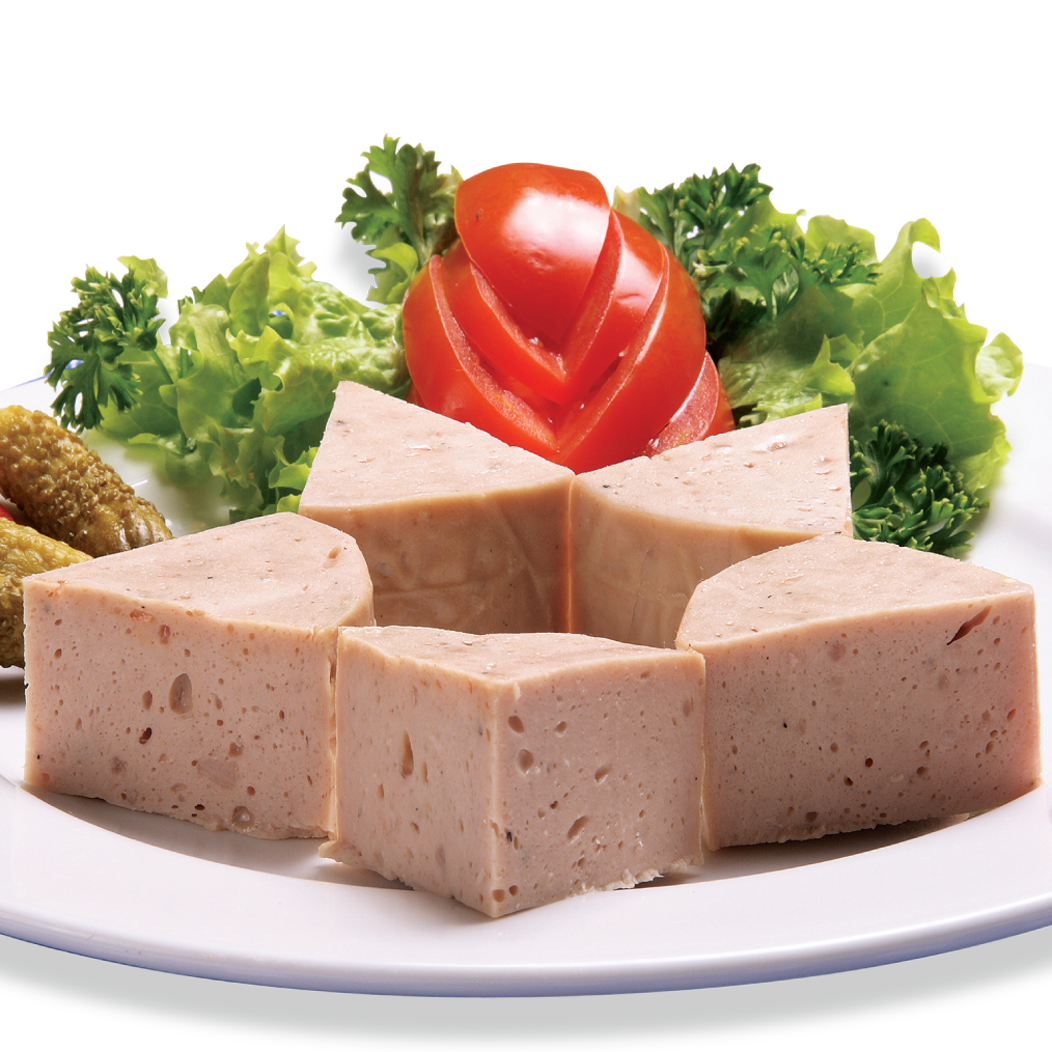
Gio Lua (Boiled Lean Pork Pie)

Pork may be processed in various ways: pie, sausage, jambow, roast pork, etc. Giò lụa is a typically Vietnamese specialty.

Giò lụa is available in all corners of Viet Nam but the best may be that of Hà Nội made by the inhabitants of ước Lễ village (former Hà Đông province), Mr. Liu, a man reputed for his making of giò lụa, once told writer Nguyễn Tuân: “Not any pork can be used for giò lụa. Frozen pork can’t be pounded. Meat must be fresh.

Gio Lua Vietnam
Giò Lụa
When cutting the pork, you must be careful not to cut your finger. The pounding requires hard work. If meat is pounded in an irregular manner, it will be spoiled. In the past, there was no electric fan. When I pounded meat, my face, my body sweated but I continually pounded in spite of mosquito bites and other distractions.

When I was tired, I looked at my grandchildren who would pour a cup of alcohol into my mouth... It’s not necessary to pound with great strength but continuously and regularly’ When I hear the beating of giò, I can guess whether it is spoiled or not. I don’t know how long ago my ancestors taught us this trade but at the temple dedicated to the cult of our ancestors there are always two wooden pestles, red lacquered and gilded about lm long. To be frank, I think, if a man does not know how to pound meat regularly, he is like a builder not knowing how to pour concrete...”

Gio Lua (Boiled Lean Pork Pie)
Gỉò Lụa (Boiled Lean Pork Pie)
After the selection and pounding of the meat, it is necessary to have banana leaves for packing.
The outside cover is made of old banana leaves and the inside cover, young yellowish banana leaves. The flavor of giò lụa comes from those of properly pounded meat and of fresh banana leaves after they are boiled. Giò lụa can be eaten separately or with rice, vermicelli or used in the preparation of other foods.